

What an Architectural Digital Twin Actually Is
An architectural digital twin is a real-time, interactive digital environment built directly from a project's technical data — BIM models, CAD drawings, material specifications — and rendered using platforms like Unreal Engine.
The key word is real-time. Unlike a traditional rendering, which captures a fixed moment, or an animation, which follows a predetermined path, a digital twin is live and navigable. Stakeholders can move through the project at full scale, change materials, study lighting at different times of day, or explore design alternatives — all within the same environment, without rebuilding anything from scratch.
It is not a visualization of what a project might look like. It is an accurate, evolving representation of what the project will be.
How It Works Across a Real Project
The most useful way to understand a digital twin is not as a product but as a process. Here is how it typically functions across the stages of a development.
Early design — validation at real scale
The first place a digital twin earns its value is in design validation. Drawings and static models can obscure spatial problems that become immediately obvious at 1:1 scale. Ceiling heights that feel generous on paper feel oppressive in the environment. Circulation paths that look efficient on a plan create bottlenecks in practice. Proportional decisions that seem resolved in section reveal themselves differently in space.
Experiencing these things in a navigable environment — before anything is built — allows design teams to make informed decisions when changes are still straightforward and cost-effective. It is the difference between resolving an issue in the digital model and resolving it on a construction site.
Design development — lighting, materials, and real decisions
As the project develops, the digital twin becomes a testing environment for the decisions that define the quality of a space.
Natural lighting can be studied as it will actually occur — not approximated, but simulated accurately across times of day and seasons. Material and finish options can be compared in context, not on sample boards under artificial light. Layout configurations can be adjusted and evaluated in real time, with the full spatial consequences visible immediately.
This phase is where the digital twin tends to have the greatest impact on design quality, because it replaces approximation with accuracy.
Coordination and stakeholder communication
Complex projects involve multiple teams, consultants, and decision-makers who do not always share the same mental image of what is being built. Misalignments between design intent and execution are one of the most consistent sources of costly change requests during construction.
A shared digital environment gives every stakeholder — architects, developers, contractors, investors — access to the same accurate representation of the project. Design conflicts and coordination issues can be identified and resolved before breaking ground. This proactive approach can reduce change requests by up to 35%, with direct implications for timelines and budgets.
Sales and marketing — one environment, every asset
Once the design is approved, the digital twin becomes the source for the entire marketing asset package.
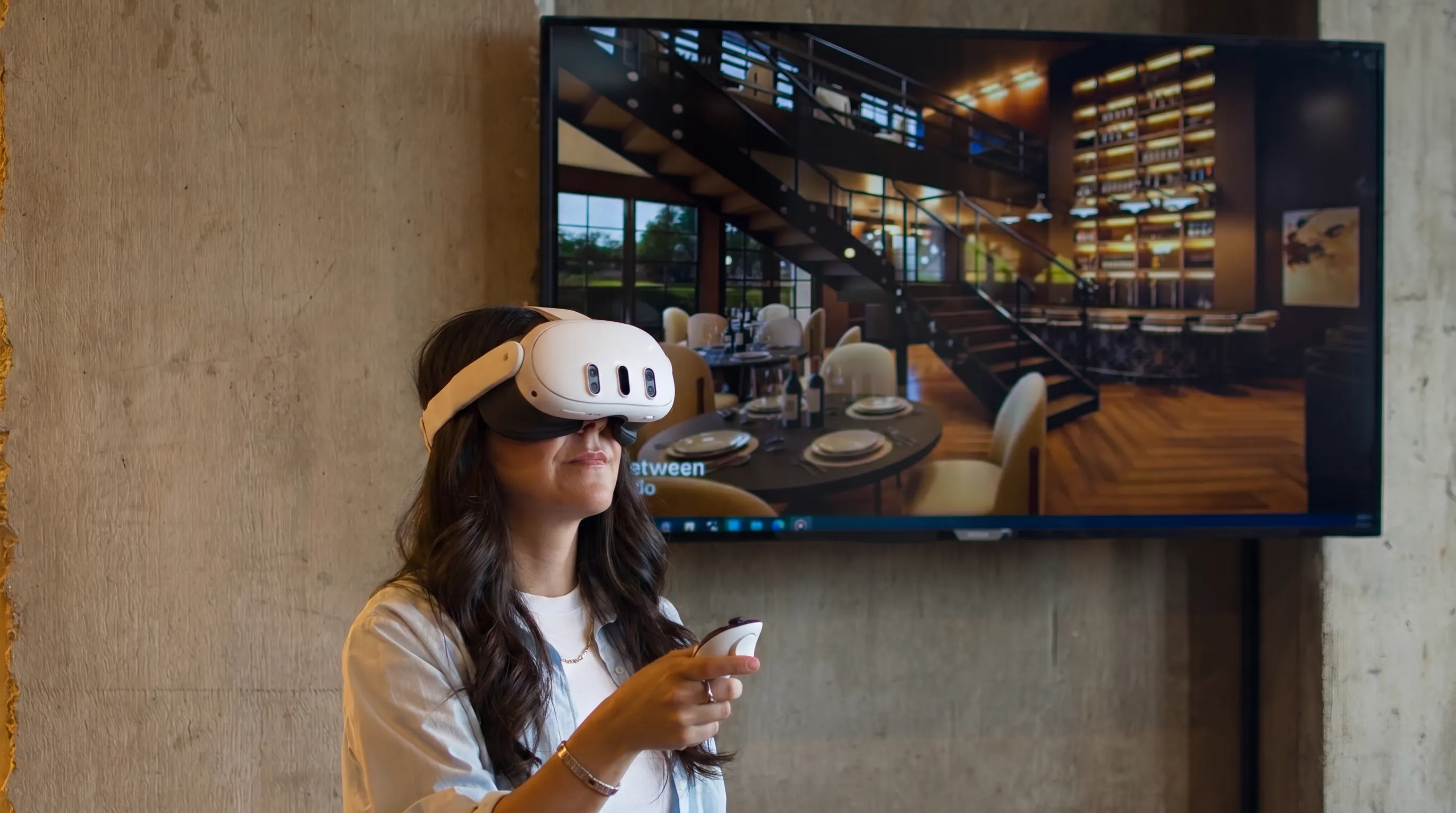
Because everything lives in a single consistent real-time scene, that same environment generates photoreal renderings, cinematic animations, 360 online tours, and fully immersive VR experiences — without rebuilding models or briefing separate vendors for each output. Every asset shares the same materials, lighting, and spatial accuracy, so the project looks cohesive across every channel.
This is one of the most significant practical advantages of the digital twin approach. The marketing package is not a separate production effort. It is a direct output of the environment that was already built.
Virtual showroom — selling before construction is complete
The same environment that supported design decisions becomes a 24/7 virtual showroom for buyers and tenants.
Prospects can explore residences, amenities, and common areas fully — at any time, from any location — with a spatial understanding that static images cannot provide. The experience communicates scale, quality, and atmosphere in a way that accelerates confidence and decision-making. Developments using immersive virtual showrooms have seen deals close up to 50% faster than those relying on traditional sales materials.
Why Developers Are Adopting This Approach Now
Several things have shifted in recent years to make architectural digital twins a practical choice for a wider range of developments.
The technology has matured. Platforms like Unreal Engine now deliver architectural-quality real-time rendering at resolutions and fidelity that were not achievable at practical budgets even five years ago. The barrier to entry has lowered significantly.
Pre-sales pressure has increased. Developers need to generate demand and close deals earlier in the process, often long before construction is complete. A virtual showroom that operates independently of construction progress gives sales teams a genuine tool rather than a promise.
Projects are more complex. As developments grow in scale and involve more stakeholders, the cost of misalignment grows too. A shared digital environment that keeps every team working from the same accurate source reduces that risk in a measurable way.
Competition for buyer attention is real. In markets where multiple developments are competing for the same buyers, the quality of the sales experience is part of the product. Immersive, interactive environments stand out against brochures and static renderings in ways that are difficult to ignore.
From Concept to Closing
The reason the digital twin approach works is not because any single capability is revolutionary. It is because the same environment serves the entire project lifecycle — from the first spatial decisions through to the final sale.
Design validation, stakeholder collaboration, risk reduction, marketing production, and sales enablement are not separate efforts requiring separate tools. They are different uses of the same asset, built once and deployed continuously.
That continuity is where the real value is.